Cold Rubber, Clear Verdict: Winter Tyres for UK MINI Drivers in 2026

MINIs are built around feel. The steering, the short wheelbase, the way a Cooper S turns a mundane roundabout into a small event — it all depends on what is happening where the rubber meets the road. So when the temperature drops and the forecast starts throwing frost, rain and the occasional optimistic flurry of snow at us, tyres deserve more than a glance at the tread depth gauge.
The catch is that Britain is not Finland. Our winters are mild, damp and wildly inconsistent. One week brings -3°C and icy lanes; the next brings 11°C and drizzle. That makes the winter tyre question more nuanced than a simple “fit them or don’t”.
First, the British weather caveat
UK law does not require winter tyres. Unlike some European countries, there is no compulsory cold-weather tyre season here. That means the decision is yours, and it should be based on how and where you actually drive your MINI rather than a calendar date.
If you live on a hill, commute along untreated country roads, or regularly leave early before the gritters have done their rounds, winter rubber can be a genuinely sensible safety upgrade. If your MINI spends most of its life on busy A-roads and supermarket car parks in a city, a good all-season tyre may be the more practical compromise.
What is not sensible is assuming that a standard summer tyre behaves the same at 2°C as it does at 16°C. It does not.
Winter vs all-season vs summer: what actually differs
Summer tyres are designed to work best in warmer conditions. The compound is formulated to stay flexible and grippy when the road is relatively warm. As temperatures fall towards around 7°C and below, that compound can harden, which reduces the bite you feel through the steering and under braking. On a dry cold day you may not notice much. On a damp, greasy B-road, you probably will.
Winter tyres use a softer compound and a more aggressive tread pattern with lots of sipes — the small cuts in the tread blocks. Those sipes help the rubber key into snow and ice, and the softer compound keeps working when the mercury drops. The trade-off is that winter tyres can feel less precise and wear faster in mild, warm weather. They are not magic, and they are not much fun if you leave them on through a 20°C May.
All-season tyres sit in the middle. A proper all-season tyre — look for the three-peak mountain snowflake symbol, not just “M+S” — is designed to cope with a broad range of temperatures and light wintry conditions. It will not match a dedicated winter tyre on packed snow or ice, and it will not match a summer tyre on a hot dry track day, but for many UK MINI owners it is the pragmatic year-round answer.
Is your MINI’s factory fit up to it?
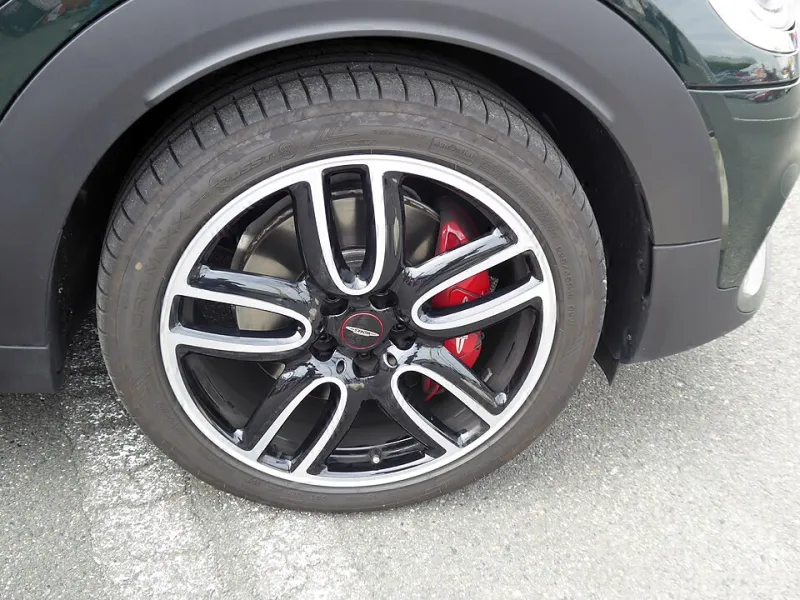
This is where things get model-specific. MINIs leave the factory on a variety of tyres depending on model, wheel size and specification. Some come on summer rubber, some on all-season, and performance models such as the John Cooper Works may be fitted with tyres focused more on dry grip and steering response.
Check the sidewall. If you see the three-peak mountain snowflake symbol, you have a tyre with at least some certified cold-weather capability. If you see only “M+S” without the symbol, treat it as a mild-weather marking rather than a winter guarantee. If you see neither, assume it is a summer tyre.
A standard factory summer tyre can certainly get you through a British cold snap on clear roads. It is not suddenly useless the moment the display reads 6°C. But it is giving away grip in cold, wet conditions, and it is not the right tool for snow, ice or steep untreated lanes. If your MINI is an electric model, the instant torque makes a decent cold-weather tyre even more valuable — wheelspin is easy when all that torque arrives at once.
When to switch — and when not to bother
There is no perfect date. The old advice was to switch when temperatures consistently sit below 7°C, but in the UK that can mean a few days in December and then a mild spell in January.
If you are going down the dedicated winter tyre route, late October to late November is a sensible window for most of the country. Think of it as preparing for the season rather than reacting to the first frost. Switch back in spring when the risk of hard frost has passed and temperatures are reliably in double figures.
If you are using all-season tyres, you simply leave them on. That is the appeal. You give up a little summer sharpness for year-round convenience and cold-weather confidence.
What you should not do is mix tyre types across an axle or run two winters and two summers. That can create unpredictable handling, especially under braking or in a sudden downpour. Four matching tyres is always the cleaner answer.
Storage, insurance and the boring bits that matter
If you run a second set of wheels and tyres, store the off-season set properly. Clean them, let them dry, and keep them in a cool, dark, dry place away from oily rags, solvents and electrical equipment that produces ozone. Stack them flat or hang them, and mark which corner each came from so you can rotate them next season.
Insurance is worth a phone call. Many UK insurers take the view that winter tyres are not a modification if they are the correct size, load rating and speed rating for your MINI. But rules vary, and if you are changing wheel size or fitting something non-standard, tell your insurer. It takes ten minutes and avoids a very awkward conversation later.
Also check your tyre pressures as the temperature drops. Cold air reduces pressure, and under-inflated tyres blunt steering feel and increase wear. Reset the TPMS after a wheel change, and check the pressures when the tyres are cold rather than after a motorway run.
The Peter Vardy MINI verdict
For most UK MINI drivers, a quality all-season tyre with the three-peak mountain snowflake symbol is the smart default — especially if you want one set of rubber to handle damp mornings, cold commutes and the odd snowy detour. If you regularly drive in genuinely wintry conditions, a dedicated winter set is worth the outlay and the storage hassle.
What is not worth doing is ignoring the subject until the first icy morning, then expecting a sporty MINI on summer rubber to defy physics. The go-kart feel is a brilliant thing. But it only works when the tyres are matched to the weather.