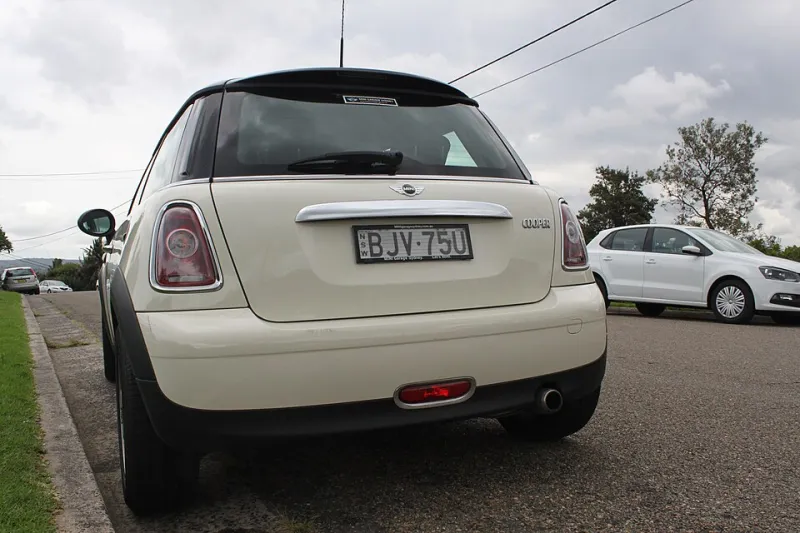
The Plate Detective: Decoding a Used MINI's Registration

Photo: Photograph by Mike Peel (www.mikepeel.net)., CC BY-SA 4.0, via Wikimedia Commons
Standing on a forecourt with a coffee in one hand, it's tempting to think the number plate tells you the whole story. A '26' plate means new, a '12' plate means old, a private plate means someone's spent money on it. That's roughly the level of plate literacy most buyers arrive with — and it's exactly the level that gets people caught out. The plate is a starting point, not a verdict. Treat it like the first clue in a detective story rather than the final chapter.
The Two Numbers That Date the Car
Since September 2001, UK registrations have followed a format that puts the age right up front: two digits, then three letters. The digits change every six months, in March and September. March plates run from 02 (2002) to 26 (2026). September plates add 50 to the year, so 52 means September 2002 and 76 means September 2026.
What that means in practice: a MINI on a '26' plate was registered between March and August 2026. A '76' plate is the newest of the new, registered from September 2026 onwards. A '52' plate is a very early first-generation MINI Hatch — one of the cars that kicked off the modern MINI story. And a 'Y' prefix plate from 2001 is a genuine curiosity: one of the earliest new-era MINIs in the country.
The catch is that the plate tells you when the car was registered, not when it was built. A MINI built in late 2025 could easily have sat in storage and been registered on a '26' plate in March 2026. That's not a problem, but it's worth knowing if you're comparing two cars that look identically aged on paper.
The First Letter Is a Postcode Clue
The first letter of the three-letter block is a memory tag — a rough regional identifier. L is London, S is Scotland, B is Birmingham, Y is Yorkshire, and so on. Two-letter tags like SA to SY point to Scotland, while LA to LY narrow things down to London.
This is fun at a cars and coffee meet, but it's not much use for a purchase decision. It tells you where the car was first registered, not where it's lived since. A MINI first registered in Aberdeen could have spent the last decade in Devon. Don't read anything into it beyond a bit of trivia.
Where the Plate Lies (or at Least Misdirects)
Private plates are the big one. A 2008 MINI Cooper S wearing 'MIN 1' tells you precisely nothing about its age. Worse, a cherished plate can be used — deliberately or not — to make an older car look newer, or a newer car look older. Neither is illegal, but both can skew a buyer's first impression.
The document that tells the truth is the V5C. Look for the date of first registration. That's the number that matters, and it can't be fudged by a plate transfer. If a seller is keeping the private plate, the car will be re-registered on an age-related plate, and the V5C should reflect that. Ask to see the updated document before you shake hands. If the plate is included in the sale, get the retention or transfer paperwork in writing — and check the V5C has actually been updated, not just promised.
One more thing: a private plate cannot hide a car's MOT history, its mileage, or its insurance write-off status. Anyone who suggests otherwise is either confused or hoping you are.
What the Plate Cannot Tell You
Plenty. It won't tell you the trim level, the engine, the gearbox, the service record, or whether the car has been in a shunt. A 2020 plate could sit on a base Cooper or a full-fat John Cooper Works, and the plate looks identical either way. It won't tell you if the car is an import that's been given an age-related plate that doesn't quite match its build date. And it won't tell you how many owners it's had, or whether the last one treated it like a member of the family or a skip on wheels.
Cross-Checking: The Paperwork Trail
This is where the plate earns its keep — as a key to unlock records, not as the record itself.
Start with the DVLA's free vehicle enquiry service. Pop the registration in and you'll get tax status, MOT status, date of first registration, colour, engine size and CO2 emissions. It's a quick sanity check: if the seller says it's a 2019 car and the DVLA says 2017, walk away.
Next, the DVSA's MOT history service. This is the goldmine. You'll see every MOT test, the mileage at each one, advisories, and failures. Look for gaps, sudden mileage jumps, or a cluster of advisories that suggest neglect. A car with 60,000 miles in 2022 and 45,000 in 2024 has a story to tell, and not a good one.
Then the V5C itself. Check the document reference number, the date of first registration, and the number of previous keepers. Match the VIN on the V5C to the VIN stamped on the car — usually visible through the windscreen or on a plate in the door jamb. If they don't match, stop.
Finally, the service record. Whether it's a stamped book or a digital record, the mileage and dates should line up with the MOT history. A service stamped at 50,000 miles two months after an MOT recorded 62,000 is a red flag the size of a barn door.
Five Questions to Ask Before You Buy
- Is the private plate included in the sale, and has the V5C already been updated?
- Can you show me the date of first registration on the V5C?
- Does the VIN on the car match the V5C and the service records?
- How many previous keepers, and does the MOT mileage history stack up?
- Has the car ever been registered abroad or re-registered under a different plate?
Ask these casually, not aggressively. A straight seller will answer without flinching. A shifty one will start talking about the weather.
The Peter Vardy MINI Take
Plates are brilliant at starting conversations and terrible at finishing them. Use the registration to pull the records, then use the records to make the decision. A well-documented high-mileage MINI is a far better bet than a low-mileage one with a mysterious gap in its history — and the plate won't tell you which is which. That's your job. Happy hunting.